
Writing Asexual Horror
What’s scarier than losing your identity?

Happy Halloween! For this special issue of the Ace Lit Corner, I’ll be diving into my own fiction writing, partially in celebration of spooky season, and partially in celebration of my first major publication with an asexual lead!
“Disentangle” is about the existential horror of “angels” that want to make humans as infinite as they are. Infinity combusts the individual identity, dissolving the single into the collective.
From my first draft of this story, which was very different than the final, I knew I wanted the main character to be aroace, to highlight the contrast of individual and collective.1 This offer, to become part of the very fabric of the universe, would be frightening to anyone, but it means something even more threatening to someone who values their identity as an individual in the way that an aroace person (who is not interested in partnered relationships) does.
I’m often interested in questions of identity in my writing, especially in ways that lend themselves to horror. I love stories about doppelgangers, clones, possession, body sharing, so on and so forth. I love asking the question: what is it that makes you you? How much can you take away and how much can you add?
I recently began to wonder if this fascination is actually related to asexuality, or, perhaps, if the way I engage with it is a form of asexual storytelling.
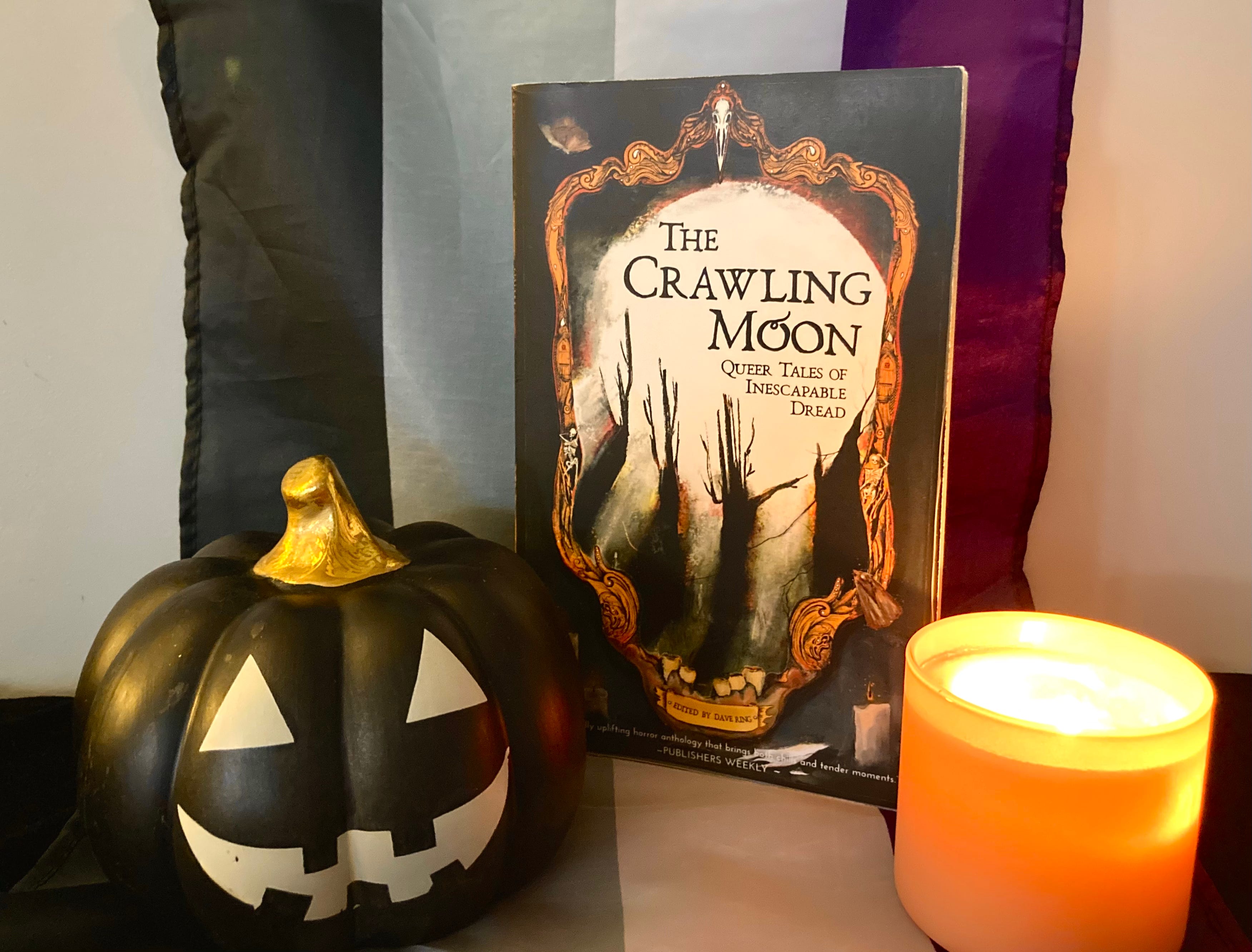
My first clue was a review of the anthology The Crawling Moon: Queer Tales of Inescapable Dread, in which the reviewer noted that my story “The Rise” was “less overtly sexual than other pieces” though there was “a strange sense of an underlying sensuality running through it, or perhaps an intimacy,” (Arley Sorg, Lightspeed.)
I didn’t intend for this story to have anything to do with asexuality—none of the characters are asexual and I wasn’t thinking about writing “through an asexual lens” at the time—though I suppose any story I write is going to have some tinge of asexuality in it. (Because of who’s writing it. Me.)
Then I read Cody Daigle-Orians’s review of Together, a body horror film in which a newly engaged couple lose their individual identities. Cody claims the film as an aspec horror film because it represents “exactly what so many ace and aro people are afraid of.” Namely, “Together paints [allonormative, amatornormative, etc.] norms as consuming cancers on being an individual. We are constantly pushed to tie our lives and our selves up with one other person who “finishes our sentence,” but Together condemns that as essentially an act of self-destruction.” (Cody Daigle-Orians, Ace Dad Advice.)
And there I clearly saw the link to the horror I was writing and asexuality. “The Rise” is not an overtly sexual piece, in the sense that there is no on-screen sex, but there is a “strange sense” of “intimacy” that contributes to the horror because intimacy is the horror in that story.
“The Rise” opens with Vega, a diver who collects valuables from the sunken parts of a city that is being consumed by endlessly rising tides. She stumbles upon a graveyard in the depths and steals the jewelry off a corpse that belongs to the monster, an immortal creature that hops from one human body to the next by contact of dead flesh to live flesh. It takes time for the creature to assume control over her body, as the tiny particles stuck under Vega’s fingernails slowly infect her.
Vega has two relationships in his story. One to her partner, Song, and one to the monster.
In her relationship with Song, both women have independent identities. Vega is out diving most days, while Song grows plants for her herbal remedies and takes house calls to heal the sick and injured. The love and care they have for one another is clear, but they are not attached at the hip. There is a healthy amount of distance between them.
In contrast, as the creature begins to take over Vega’s body, she experiences the horror of a too-close relationship. She feels another person inside of herself, crossing the boundaries of body and identity, until Vega does not exist anymore; she is completely absorbed by the creature.
I say absorbed, because it is not as though she is erased. The creature enjoys dissolving parts of its hosts’ identities into itself. In this case, it absorbs her love for Song, though in the hands of the creature, that love becomes a violent, consuming thing, because the creature lives to consume.
This leads us back to “Disentangle.” While this story is much more obviously an asexual story thanks to the main character’s orientation, it also follows this outline of asexual horror in plot and theme.
The threat the angel poses to the heroine, Anna, is to her individuality. The angel is offering immortality through collectivization, but in order to live forever in this way, the individual has to die. Angels do not have names, do not have faces, do not even have a language to speak to one another in, because there is no need to communicate between beings that already know everything the other could possibly say. There is a terrible stagnancy to this idea of infinity. If everything is already known, nothing can possibly surprise you.
In contrast, the angel is fascinated by human individuality. It asks Anna questions about love and death and her complicated relationship with her parents. It makes her think about her sexuality and her mental health in new ways. Inadvertently, by showing Anna the horror of potentially losing everything that makes her her, the angel reinvigorates her will to live.
In both stories, the main threat is to the character’s individuality; the monsters are entities that subsume others into them, whether in the form of a couple or a collective. If the core of horror reflects our real-world fears, then these monsters represent a fear of one’s identity being consumed by others, a fear of relationships that consume and obscure our individual parts.
That’s what makes them asexual horror, in my opinion. Asexuality values individual autonomy, in both a physical and metaphorical sense. Asexuality fears threats to the borders of our being. Thus, asexual horror makes these threats the monster.
Both stories also deal with other horrors. The Rise is also cli-fi, and much of the atmospheric horror comes from the post-climate-collapse setting. Distentangle is also a story about mental health and queerness in tension with Christianity, and thus the angel simultaneously represents the loss of identity, suicidal ideation, and Anna’s religious trauma from her upbringing.
What connects these two stories—the loss of individuality or the threat of it—is what makes them both asexual horror.
Which is not to say, of course, that these topics are always written about from an asexual lens. For example, cannibalism also falls into this category of “ego death” horror, but it’s almost always used in an explicitly sexual way to show the depth of desire and attraction. If horror is about taking things to the extreme, cannibalism stories are usually about taking sexual desire to the extreme, and the horror comes from asking “what if we couldn’t restrain our desires?” not “what if this relationship kills the singular me?” or “how does intimacy destroy the boundaries of self?” (Although these questions may still come up despite authorial intent.)
So, no, not every story about body sharing or possession or cosmic threats to individual identity is an asexual horror—but they have great potential to be if we ask the right questions.
I feel it’s worth mentioning, this story is not about individualism in the capitalist, pull-yourself-up-by-your-bootstraps sense. Collective care and community are awesome, important, queer things. The “collective” I’m referring to in this story is one that erases individual identity. Given the themes of the story, a clearer parallel could be drawn to a conservative church community and the brand of “normal” they expect everyone to adhere to. The angel represents many things, but it does not represent the things that could save the protagonist.
Woohooo on the new publication! And I love a good self-writing analysis by the author (and this is a VERY good one).