
What is an Ace Reading?
Reading 'The Hunger Games' through an asexual lens.

You may have heard of the concept of a queer reading of a text; a strategy of literary criticism wherein you read a text through a queer lens, extrapolating new meanings from themes, characters, and plot, that may or may not have been intended by the author, but which nonetheless are supported by the text itself. Sometimes, this involves merely exhuming the latent queerness of a text from the heteronormativity burying it, but sometimes a queer reading entirely transforms a work beyond anything the author could have possibly imagined. While they do different things, both forms of queer reading are entirely valid, so long as we recognize that the queerness we discover often has more to do with the perspective of the reader than the intent of the author.
I’d like to suggest we can do something similar by reading texts through an asexual lens. An ace reading, then, would use the framework of asexuality to inform the analysis and understanding of a text.
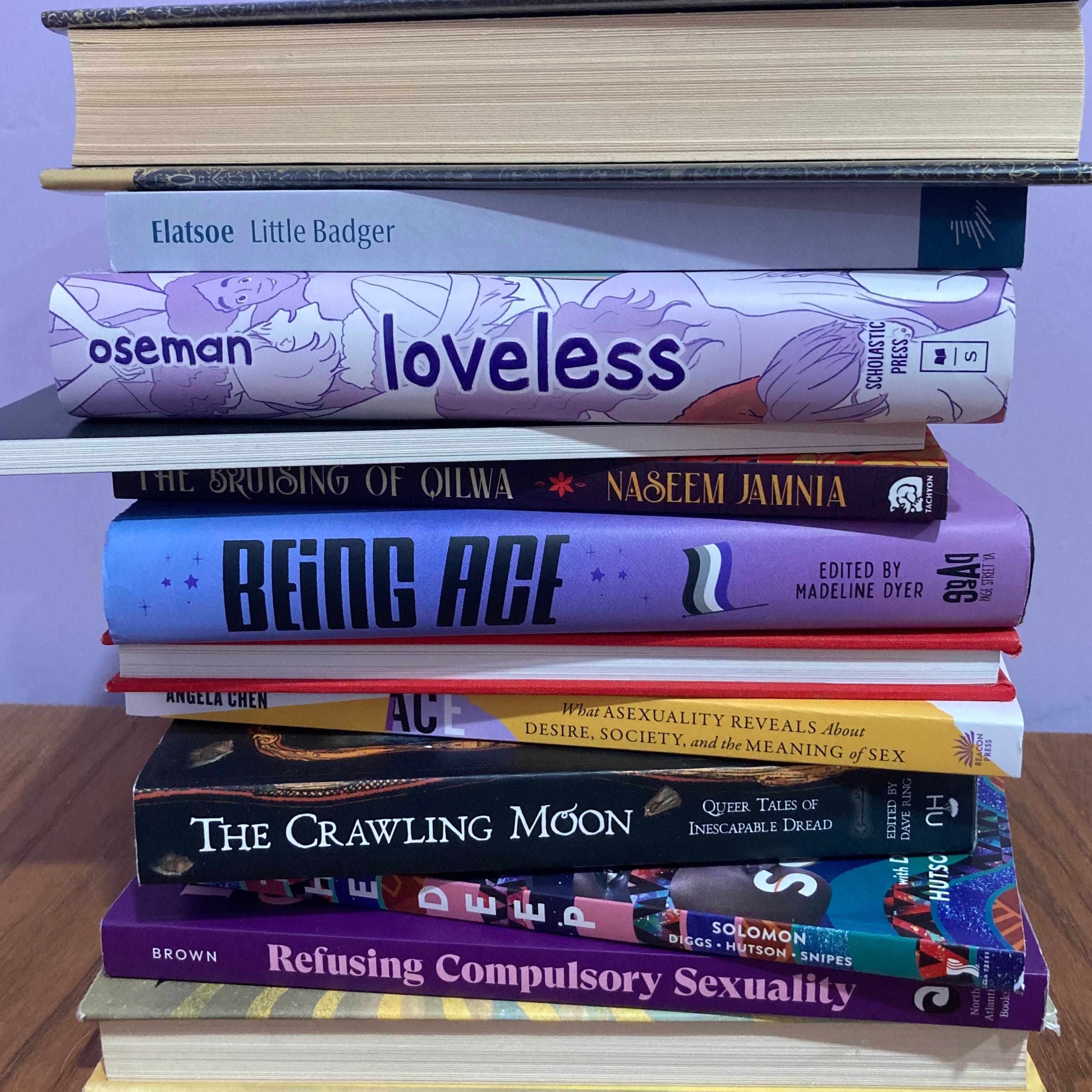
Let’s break this down into two basic strategies: an ace reading of a text as a whole, and an ace reading of a particular character.
Reading a character as asexual is similar to another concept you may be familiar with, the “headcanon.” However, where a headcanon about a character's asexuality (or any sexuality, or other characteristic) has no responsibility to be grounded in the text, an ace reading is an interrogation of a text.
Don’t get me wrong, I love headcanons, but they’re a matter of personal enjoyment and imagination. While they may be based on textual evidence, they also may be entirely arbitrary. For example, it may be as simple as “I relate to this character, so I’m going to give them some of my traits.”
An asexual reading looks more like interpreting a character’s actions, dialogue, and narrative choices to show why they might be asexual, and how that affects our understand that character, in the context of the work of fiction they inhabit. An ace reading will, at minimum, show that a character’s choices or personality mesh with an understanding of asexuality, and at its finest, will show how reading this character as asexual affects the reader’s understanding of the character, their relationships, their story line, and the message of the text as a whole.
What I’m saying is, an ace reading is a strategy we might choose to employ in writing literary criticism, and a headcanon is a fun idea to play around with in our imaginations, with our friends, or in the creation of fanworks.
Here’s an example of how we might do an asexual reading of Katniss Everdeen from The Hunger Games by Suzzane Collins.1
While Katniss is presented as someone who is attractive to others—Gale and Peeta both express clear attraction to her at various points in the series—she does not seem to express much attraction to others in return. In the first book, she largely sees her relationship with Peeta as a performance for the sake of winning the Hunger Games, and seems confused and perhaps even distressed when Peeta tries to continue their relationship after the games are over. She doesn’t seem particularly attracted to anyone over the course of the series, and when she does eventually engage in a “real” relationship with Peeta, what she gets out of the relationship seems to be more like comfort and stability than a strong, passionate connection. Thus, it’s possible Katniss could be asexual.
If Katniss is asexual, this would change the stakes of what she has to do to win the Hunger Games. Peeta is the one who instigates their relationship by proclaiming his love for her on Caesar Flickerman’s show, and once they are in the arena, Katniss realizes feeding into a love-story narrative will increase her chances of receiving sponsorships, which will help her survive. She doesn’t have much choice in the matter, and she spends most of the first book being confused about how authentic her feelings for Peeta are, since she’s been put in this love-or-death situation.
On top of that, there is no privacy in the arena. Her performance is 24/7, because there could be cameras anywhere, capturing their love story and broadcasting it to the entire country. This would be difficult for anyone, but asexuality changes the nature of the performance. She has to sacrifice privacy, agency, and the very facts of who she is to survive the Hunger Games, because expressing her asexuality wouldn’t make for good TV.
We can also read an entire text through an ace lens, not just a single character. This strategy has more to do with understanding the plot and themes of a text from an asexual and/or aromantic perspective, which usually means that the text is either uninterested in attraction as a driving force of the narrative, or has something atypical to say about attraction, love, romance, and sex.
When we read a text through an ace lens, it does not necessarily mean reading all—or even any—of the characters as asexual. Characters may still experience attraction, enter into relationships, or have sex, but the narrative might treat these things as less important or out of focus. Perhaps platonic relationships are valued above romantic and sexual ones; perhaps the central relationship of the text falls outside of any typical label; perhaps an ace narrator’s perspective colors the entire presentation of the story; or perhaps the themes and plot comment on the way society obsesses over sex and romance. There are so many ways a text can be read through an ace lens, and I would argue nearly any text can be read this way, though some will have more obvious connections to the ace perspective than others.
It’s even possible to read a sexually explicit text through an ace lens. We might ask what the plot and characters tell us if we de-center their sexual relationships, if we don’t get lost in the whirlwind of attraction and arousal. It may entirely change the meaning of the text, but sometimes that’s what literary criticism does.
Sometimes, however, a text seems to want to be read through an ace lens. I think that’s the case with our example for this piece: The Hunger Games.
I’m hardly the first person to point this out, but the series as a whole seems to be commenting on the way society obsesses over “the love story.” Katniss and Peeta’s on-screen relationship serves as a distraction for what’s really going on—a rebellion. And it’s true, too, that as the series became popular, a version of this phenomenon happened in real life. The books became synonymous in the public consciousness with dystopian YA romance, love triangles, and schlocky books for teenage girls. But anyone who’s actually read (and understood) the series knows that the books are hardly even about the love story. What The Hunger Games is really interested in is exploring wealth disparities and class divides, oppression, revolution, celebrity culture, and trauma. The book asks us serious questions about what ends could possibly justify violent means and what happens to the mental state of people who are thrust into the spotlight without their consent. All this is lost when we boil it down to a dystopian YA romance.
Thus, an ace reading of the text might look like this: The Hunger Games series is interested in investigating society's obsession with love and romance. The main characters perform a love story for an audience, and this is used to conceal increasingly revolutionary actions. In the first book, it paints their refusal to play by the rules of the game as an act of dramatic romance, when really it’s an act of defiance. But it works; the people of the Capitol, and the entire country, become so invested in their love story that there is no other option but to save them both when they threaten to commit double-suicide. In the second book, they play up their relationship even further, claim they got married in secret and that Katniss is pregnant, and once again it’s a performance for an audience, making sympathetic characters of themselves to distract from a real revolutionary plan. Katniss and Peeta are oblivious or in-on this strategy to varying degrees at different points in the books, but it is a strategy to manipulate the sympathies of a romance-obsessed society.
Furthermore, the books also ask the question of how this hurts the people playing in this charade. For Katniss, pretending to experience attraction she isn’t sure she really does makes her feel trapped in a role she didn’t sign up to play. For Peeta, who is attracted to Katniss, realizing that Katniss was mostly pretending and then having to continue the performance through his feelings of hurt and betrayal is equally distressing, even if he tends to hide it better. Thus, the story shows us that this obsession with love and romance hurts everyone who gets caught up in it, whether they’re ace or not.
I’m writing about ace readings for two reasons. One, because I really hope to see this used more as a strategy of literary criticism, and so I want more people to be exposed to it and understand it. Two, because I plan to discuss books here on the Ace Lit Corner that do not canonically contain ace and/or aro characters, and I’ll be doing that by reading these books through an ace lens.
Are there any books/stories in particular you’d like to see me talk about? Let me know in the comments!
Until next time,
-Amelia
I’m really only doing a brief interpretation of The Hunger Games, which means, yes, I may gloss over some things. I think Katniss is more likely on the ace and aro spectrums than simply asexual, but it is possible to read her as just asexual, and that’s what I did here for the sake of simplicity.
Also, I chose this example because there’s a long history of asexual and aromantic people identifying with Katniss. It’s kind of a classic example of an a popular ace headcanon. Here’s a few other sources that discuss it, if you’re interested:
https://between-the-shelves.com/2016/11/katniss-everdeen-is-asexual-and-why-thats-important/
https://www.asexuality.org/en/topic/161165-what-do-you-think-of-reading-katniss-everdeen-as-ace/
I love the way you describe the aspec reading framework! I didn't notice this nuance in the Hunger Games when I read it back in high school. I have seen a lot of discussion about Katniss as aro- and/or ace- spec. And I am interested in rereading the story now through an aspect lens!
this is such an amazing framework! i’d never considered through an ace lens and love the differentiation between reading ace as a whole or a particular character. very cool ✨