
Becoming The Other
The raw horror of compulsory sexuality in 'Earthlings'

Sayaka Murata’s Earthlings is a book about being othered and becoming other.
We first meet the protagonist, Natsuki, as a child on her way to the annual summer gathering at the family home on the mountains. Her parents clearly favor her older sister, and so Natsuki copes with her neglect through daydreaming. She imagines herself as a magical girl who’s been given powers by her stuffed hedgehog, Piyyut, who’s actually an alien from planet Popinbopopia. Her games expand when she plays with her cousin Yuu, who thinks he’s an alien stranded on Earth, and they combine their worlds to decide that his home planet must be Popinbopopia.
It’s clear that Yuu’s imagination games come from a place of deep childhood neglect, too, but where he seems to adjust to adult life for the most part after the pair are separated, Natsuki’s daydreams become her reality. Trauma, victim-blaming, and isolation offer Natsuki nowhere safe to land as she grows up. She is othered to the point of believing, truly believing, that she is something other than human.
This kind of story is not unfamiliar. There’s a reason queer folks gravitate to monster stories—we relate to the experience of the “other.” In Earthlings, however, the primary factor in Natsuki’s othering, at least in her adult life, is her resistance to sex. In that sense, this is a story about asexual othering—or it can be read that way.1
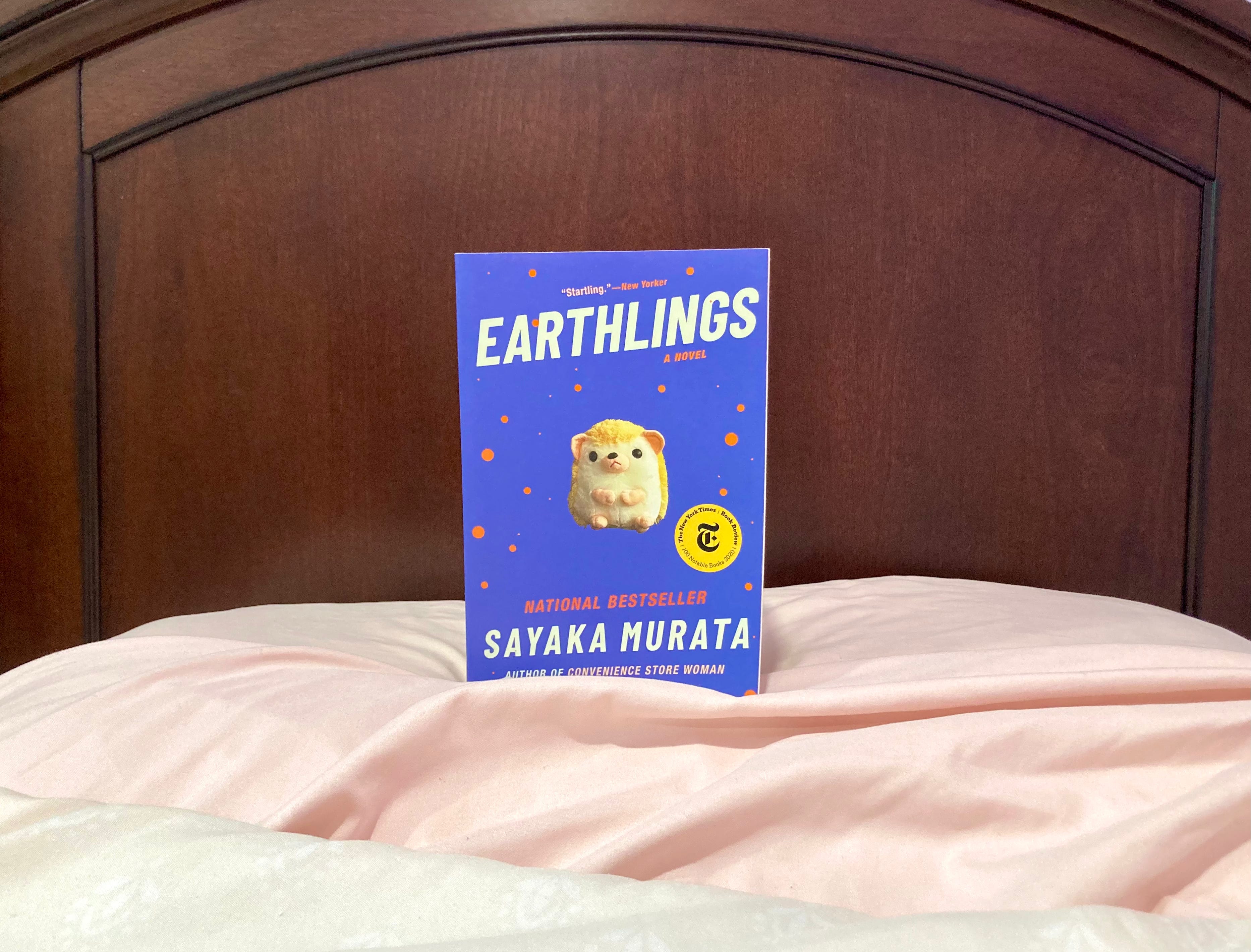
Prior to reading Earthlings, I think I was not given ample warning for what this book would entail, so I’m going to do so now, for you. While I don’t plan on talking in-depth about most of this, Earthlings itself deals with numerous sensitive topics including sexual assault, grooming, incest, murder, and cannibalism. The way in which it deals with these topics is incredibly interesting and unlike anything I’ve ever read, so I don’t say this to scare you away from reading it, but to put a big, red, glowing warning-sign over the first page.
(There’s a single-word review from the New Yorker on the cover that just says “Startling,” and honestly, that is accurate.)
The most interesting aspect of the novel, for me, is the way that the main character describes the hegemonic systems of heteronormativity, patriarchy, and capitalism as “The Factory.”
The use of this language is not metaphorical for Natsuki. She means it literally. However, from her odd interpretation of how these systems work towards encouraging heterosexual couples and childbearing, we can glean a lot of truth. It is, for the reader’s purposes, a good metaphor.
Here is how she first describes the Factory:
“My town is a factory for the production of human babies. People live in nests packed closely together. It’s just like the silkworm room in Granny’s house. The nests are lined up neatly in rows, and each contains a breeding pair of male and female humans and their babies. The breeding pair raise their young inside their nests. I live in one of these nests too.
The baby factory produces humans connected by flesh and blood. Eventually we children will also leave the factory and be shipped out.
Once shipped out, male and female humans are trained how to take food back to their own nests. They become society’s tools, receive money from other humans, and purchase food. Eventually these young humans also form breeding pairs, coop themselves up in new nests, and manufacture more babies.”
(35-6)
This perspective comes to us from Natsuki as a child, but she carries the idea with her into adulthood. She decides she must have somehow avoided becoming “brainwashed” by the Factory, because she doesn’t want to get married, have sex, and make babies.
When Natsuki does get married, it’s a contractual relationship with a man who also does not want to have sex and raise children. They meet through an online service for people “seeking to evade society’s gaze” where they both express interest in a marriage of convenience for the sake of appeasing their families (103). They operate as roommates, dividing chores diplomatically and sharing amicable conversation, though they don’t seem particularly close even as friends.
What they have in common is their belief in the Factory and the Alien Eye.
See, Natsuki’s childhood games become enmeshed with her adult worldview. She now believes that she was alien from Popinbopopia all along, and that this is why she cannot integrate with the Factory—she’s not an “earthling,” so the Factory’s brainwashing failed on her. Her husband believes he’s been turned into an alien and now possesses the “Alien Eye” to see society for what it is (the Baby Factory).
However, whereas Natsuki’s husband wants to actively resist the Factory’s brainwashing, Natsuki wishes she could succumb to it.
Her belief in the Factory makes her feel “broken” because she won’t “ever be able to be an effective Factory component” so long as she can’t have sex (103). Living under the Factory’s scrutinizing gaze without being brainwashed feels like a burden to her, because “anyone who remained unbrainwashed had to keep up an act in order to avoid being eliminated by the Factory” (106).
When she and her husband briefly evade the watching eyes of the Factory by taking a trip back to Natsuki’s family home in the mountains, the relief of being unscrutinized for once feels impossible to uphold. Natsuki knows it will not last long, and instead yearns to be finally fully integrated with the Factory:
“We both felt it. It wouldn’t be long before an envoy would arrive from the Factory. We were shirking our responsibilities as components and would soon be forced to return. And actually, I was longing for that envoy. We would be taken back to the Factory, where my husband would be put to work, and I would be calmly but coercively convinced to have a baby. Everyone would lecture me on how wonderful it would be.
I was ready for it. This time everyone would ensure that I was perfectly brainwashed, and my body would become a Factory component.
My womb and my husband’s testes did not belong to us. The sooner I was brainwashed the better. That way I would no longer suffer. I, too, would be able to live with a smile on my face in the virtual reality world in which everyone was living.”
(160)
Though Natsuki’s language around the Factory seems extreme, the extended metaphor of the Factory highlights how intensely she experiences the pressure to conform.
Though neither she nor her husband outright claim asexuality as an identity, the main reason they are scrutinized is for the lack of sexual intimacy in their marriage—and, therefore, the lack of children produced by their marriage. Natsuki feels like an alien because she is alienated; Natsuki feels like a broken factory component because she is treated as a broken person.
Likewise, her longing to be “brainwashed” by the Factory is understandable. She wishes she could be happy and fulfilled within the structures of happiness and fulfillment society has set out for her. She doesn’t see an alternative, so she doesn’t seek one.
At least, not until later in the novel, when things take a horrific turn. Although, I would argue, Natsuki’s entire life has been horrific, so the new horror at the end of the novel only feels worse for its novelty, and that’s part of the point the author is trying to prove.
There are larger examples of horrific things in this book—I listed a few of them for you already—but the horror creeps through in subtler ways, too. Especially so when it comes to the unsettling language of the Factory theory.
Take this simple comment about a side character, for example: “Everyone also called Miss Shinozuka an ugly old spinster who’d missed the boat” (45). Though rude, it’s not anything any reader should be unfamiliar with. People say these things, or at least think these things, all the time.
Then Natsuki-as-narrator jumps in and phrases it differently: “Miss Shinozuka functioned well enough as one of society’s tools, but maybe she wasn’t functioning properly as one of society’s reproductive organs” (45).
Comparing a person to a reproductive organ sounds so much worse, puts the unsettling image of a walking uterus into our minds, and yet it’s not really any different from calling her an “ugly old spinster.” Both phrasings claim the purpose of a woman to be nothing more than a baby-incubator, but only Natsuki’s Factory language shocks us into remembering how horrible that truly is.
This comes across even clearer in this moment, where Natsuki visits a friend who has just had a baby.
“The baby she had produced was sleeping in its cot in the living room. Shizuka’s place always reminded me of the silkworm room in Akashina. The sight of her baby lying there melded in my mind with the rows of baby silkworms in the silkworm room. I had started to think that maybe we, too, were made to breed by a huge invisible hand.”
(99-100)
Now that’s a horrific image. But for Natsuki, whose autonomy is questioned and crushed at every turn, who feels such immense pressure to participate in marriage, sex, and childbearing to the point that she wishes she could genuinely want to, it’s just reality.
She’s not a human. She’s an alien, a factory component, a reproductive organ, a silk worm.
When her parents and in-laws find out about her sexless marriage, she’s certainly made to feel less than human.
Her mother tells her: “it’s a wife’s duty to be intimate, you know. Tomoya finds it hard to hold down a job, doesn’t he? You have to support him in that regard, Natsuki. You’re his wife!” (188). Her in-laws tell her: “You married into our family, and if you don’t fulfill your duty as a wife, you’ll be causing problems for us,” before openly discussing whether she’s getting too old to have a baby and at what point they should replace her with a younger woman to ensure their son has children (191). Even her friend is recruited to badger her. “It’s only after couples get intimate the first time that they really become a couple,” she says; “if you really can’t get intimate with each other, I think it’s probably better to split up [...] A couple that doesn’t get intimate, it’s abnormal” (195).
This barrage of allonormativity and compulsory sexuality hits so hard because it comes after a long build of dehumanization. Even though we know there isn’t really a Baby Factory, Natsuki’s theory seems to glint with truth. In the eyes of her family, her friends, and society at large, she’s failing to fulfill her purpose as a tool: as a sex object and a womb.
To be clear, Natsuki and her husband (especially her husband) are not perfect victims. They, too, commit some truly heinous acts by the end of the book. But as I said, I believe part of the point of all these horrific events is to question why one terrible thing is thought of as worse than another, just because one is taboo and strange, and one is commonplace.
This is summarized quite well by Natsuki when she has a shockingly calm discussion about a potential sexual assault (that, in this case, does not occur) with her cousin Yuu (now both adults).
“That sort of thing happens everywhere, you know. We just don’t see it. Even now, someone somewhere in the world is being used as a tool. It’ll happen again today too. That’s all it is.”
“Natsuki, what you are talking about is a crime. It’s abnormal.”
“So what? Adults are expected to turn a blind eye to anything abnormal, aren’t they? That’s the way it is. Why so virtuous now? You’re just a regular adult, after all. All you have to do is ignore it, just like any other regular adult.”
(167-8)
Natsuki is, in part, speaking from experience. Her abuse was excused and diminished to the point that it now seems commonplace to her. From her own experience, the rules don’t add up. Some kinds of sex are wrong, some kinds of sex are right, and some feel horrible to her but don’t seem to matter at all to others, but choosing not to have sex is the worst sin one can seem to commit. Sexual abuse will be ignored, but not sexlessness.
No matter what she does, Natsuki will be seen as other, alien, broken, and monstrous. So what else can she become?
Where she takes her story may be “startling,” but it’s not, in hindsight, all that surprising.
Also worthy of note, in terms of how we think about and read this book, is that Earthlings was originally written in Japanese by Sayaka Murata, and the version I read has been translated to English by Ginny Tapley Takemori. The text we’re discussing is in translation, both literally in terms of language, and culturally. So much of this story is clearly about Japanese culture in particular, which is shaped by the current “national emergency” of exceptionally low birth rates. This is similar to the pro-natalist sentiments I’m familiar with in the U.S. but, of course, not exactly the same.
Wow, this sound like a fascinating book that I hadn't heard about before!