
Beyond Representation
A Love Letter to the ‘Monk and Robot’ Series

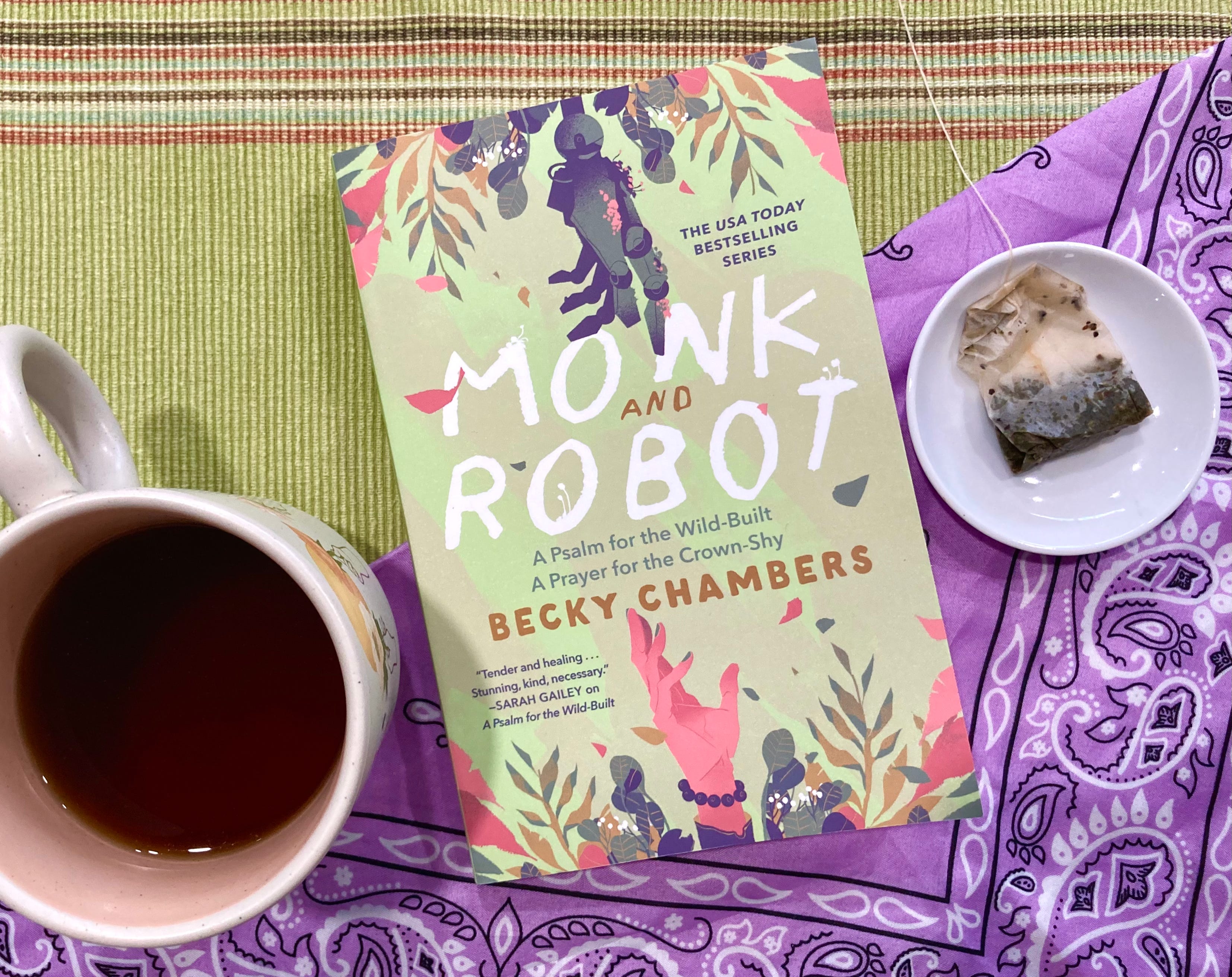
Monk and Robot by Becky Chambers is actually two books in one. The duology, A Psalm for the Wild Built and A Prayer for the Crown Shy, two short books repackaged into one longer one, which read more like two halves of one whole, rather than a prequel and sequel.
The story follows Dex, the monk, who makes a sudden decision to leave the City and travel the villages. Two years into this, they make an even more sudden decision to head into the wilds, in search of an abandoned hermitage. Here, they meet Splendid Speckled Mosscap, the robot.
In this world, all the robots collectively decided to leave human society and retreat to the wilds. Humans and robots have an agreement that the humans will not seek out the robots, and they’ve left each other well enough alone for quite some time. Mosscap has been sent out to check on the humans, but gets side tracked to help Dex on their quest for the hermitage. The first book is about Dex’s mission, and the second about Mosscap’s.
Interestingly, though Mosscap is undeniably sentient, it insists on being referred to as an object and resists humanization. This makes reading Mosscap as asexual a little bit tricky, because while it is true that the robot does not experience sexual attraction, to claim Mosscap as asexual would very much fall into the asexual robot stereotype.
However, I don’t think the book is trying to represent asexuality through Mosscap. Very little attention, if any, is drawn to Mosscap’s nonsexual nature, and it’s never used as a factor to differentiate it from humans.
Thus, in comparison to something like Murderbot, where I find reading the robot as asexual to be productive, our robot friend in Monk and Robot is better read as an allegory for asexuality, or just something else entirely.
That said, I still think there’s a lot of value in reading this book from an asexual perspective—hence why I’m writing about it. I find most of the aspec elements in the books come from the way the text treats the central relationship, not from the Mosscap’s character. So what we have here is more of an aspec narrative rather than aspec representation.
Spoilers for both books ahead!
In the first book, A Psalm for the Wild Built, Dex and Mosscap’s budding friendship can be read as an allegory for an allo/aspec relationship—or really any kind of relationship where a gap in understanding needs to be bridged. But for our purposes, we’re going to read it as bridging the gap between the allo and aspec experiences.
Dex and Mosscap, being a robot and a human, often have conflicting interpersonal needs. For example, Dex finds it rather unnerving to eat in front of Mosscap, especially when it has helped prepare their meal, since Mosscap cannot actually eat the food it has helped them cook.
Offering food and sharing a meal is so ingrained in Dex as the polite, correct thing to do, that they’re too uncomfortable to eat their own meal with Mosscap watching them empty-handed. Of course, this does not bother Mosscap at all, except that it bothers Dex.
“There’s physically no way for me to consume that” the robot explains, “Putting that inside me would harm me. Or attract animals” (110).
So obviously forcing Mosscap to eat is off the table. However, the other one-sided solution, that Dex just get over this hurdle and eat their food, is not where this scene lands. Instead, they find a compromise that accommodates them both.
Dex hands Mosscap a plate of food. It does not eat, and when Dex has finished their plate, they ask “You gonna eat that?” to which Mosscap is instructed to reply, “No, I’m done, you can have it if you want” and Dex eats a second, usually smaller, portion (112). Mosscap does not have to eat, and Dex is comforted by the act of offering it food.
In this scene, we can read an allegory for the kind of compromise an allo/aspec couple might make. They have a conflicting need, one partner wants to do this activity together, and one partner does not want to participate, or would even be harmed by participating. Neither need is treated as less than the other, and so too are the firm boundaries respected. The solution seems silly, and yet satisfies both of them, so it works.
In a similar vein, the first book ends with Mosscap attempting to perform a tea service for Dex. As a tea monk, Dex is a professional at tea service. They travel from town to town and provide tea and comfort, practically therapy, to the folks that need it.
Mosscap has seen firsthand that Dex is stressed and confused, so it decides to try giving them comfort in the way it knows Dex is most used to. Of course, the robot’s version of tea service is rather different from Dex’s. The only plant it could find that it knew wasn’t poisonous to humans was mountain thyme, so it brews an unconventional, herby tea for them with that single flavor.
Dex took the mug carefully and inhaled. The steam was earthy, bitter. It was not a pleasant smell. Dex didn’t care. There was no scenario in which they weren’t going to drink this whole mug down to the dregs. They took a sip and swirled it around in their mouth, savoring.
Mosscap watched them keenly, not moving at all. “Is it bad?” the robot asked.
“No,” Dex lied.
Mosscap’s shoulders slumped. “It’s awful, isn’t it? Oh, I should have asked you, but I wanted it to be—”
Dex reached out and laid their hand on the robot’s knee. “Mosscap,” Dex said gently. “This is the nicest cup of tea I’ve had in years.” And in that, there was no lie.
(148)
Here, we see Mosscap trying to do things the way it knows Dex is used to, and worrying that it has somehow failed by not living up to their standards. But Dex doesn’t care how the tea tastes. That’s not the point. The point is that someone who cares about them has brewed it.
To extend the allegory—we can be creative about how to meet our partner’s needs within our own skills and limitations.
A Psalm for the Wild Built is, to me, a story about learning to be in partnership with someone whose needs, wants, and boundaries are vastly different from your own. It’s about understanding and accommodating other experiences.
Mosscap laments at one point: “I wish I could understand experiences I’m incapable of having” (128). And while it’s true that it can’t understand what it’s like to actually live those experiences, it proves by the end of the book that it can understand Dex.
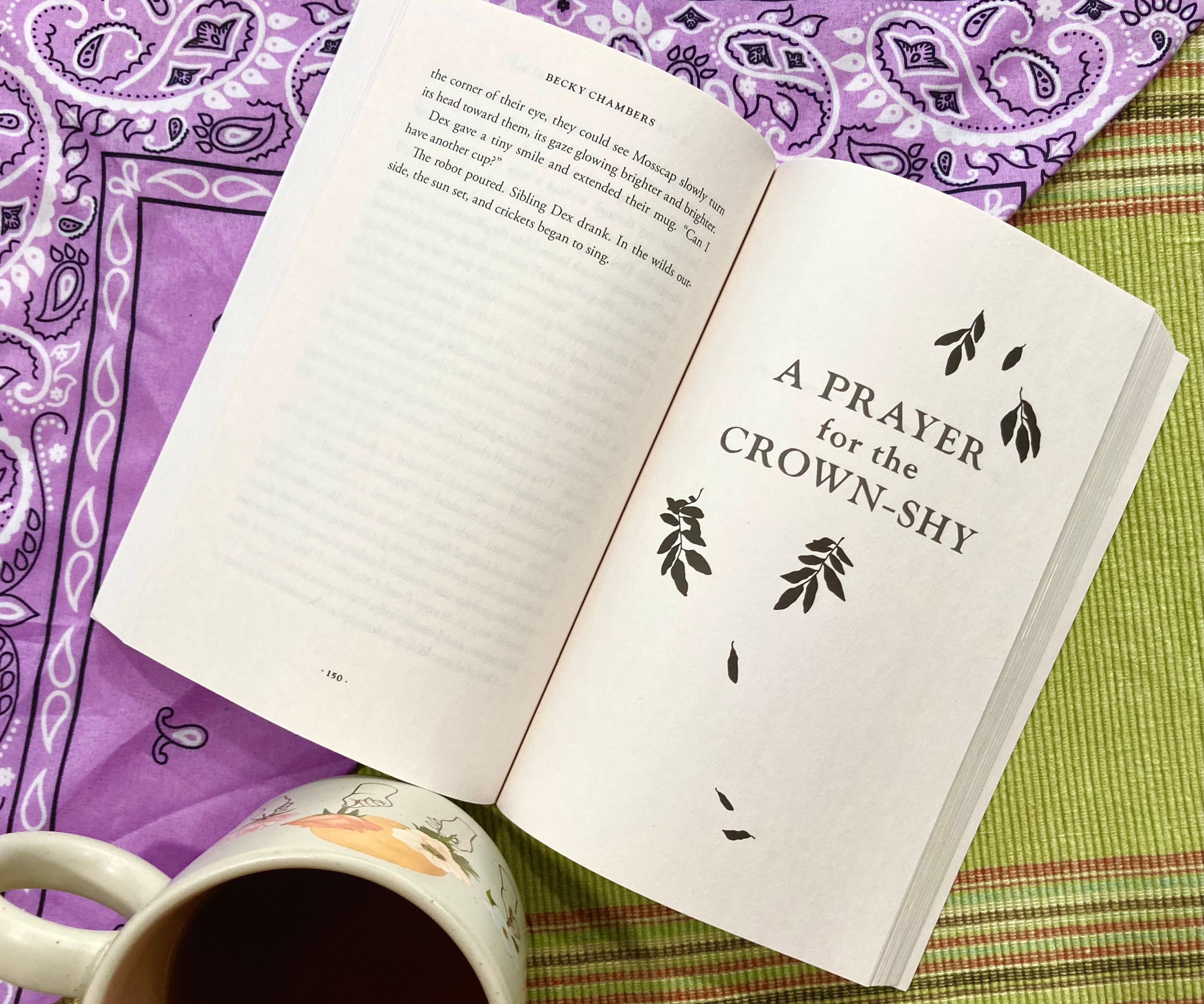
My reading of the second book, A Prayer for the Crown-Shy, is far less allegorical. I think Dex and Mosscap are, at this point, in a committed platonic relationship, and that they perhaps even enter into a queerplatonic relationship.
This comes across in the ways in which they prioritize and care for each other, as well as how the narrative centers their relationship.
About halfway through the second book, Dex meets someone who catches their eye, a young man named Leroy, and the pair briefly flirt before spending a night together. The sexual encounter takes place off the page, and is treated as an aside to the main story of the chapter; Mosscap needs a replacement part and is having trouble deciding what to do about it, since usually robots in the wild simply let themselves break down, and their parts get recycled into new robots.
Leroy is the one who can make the new part for Mosscap, so after he and Dex spend the night together, Mosscap shows up in the morning to announce its decision. Dex immediately gives Mosscap the majority of their attention while Leroy cooks them breakfast, and Mosscap pauses to ask, “should I leave? Am I intruding?” (229).
Dex tells Mosscap that it’s fine, and the narration remarks that Leroy “seemed to be taking the third wheel in good humored stride” (229). It’s clear to me now that the “third wheel” refers to Mosscap, but when I first read this, I thought Leroy was taking the position of third wheel, because the story is so clearly focused on Dex and Mosscap.
The choice to focus on the platonic relationship, rather than the sexual relationship, is a form of aspec storytelling. It’s an intentional shift from the assumed hierarchy of importance that certain types of relationships will have in a person’s life—or in a character’s story.
By the time we arrive at the end of the second book, however, it’s clear that it’s not just the narrator choosing to prioritize Dex and Mosscap’s relationship. The pair themselves choose each other over all else.
As they approach the City, the final destination of Mosscap’s tour of humanity, the robot suddenly seems hesitant to continue. They veer off course and spend a few days camping on the beach, until finally they talk to each other about the very obvious reason for their delay.
Mosscap says, “I don’t want to go to the city, because the City is the end,” which Dex intuits to mean both the end of their travels, and presumably, “the end of their companionship” (290-1). What they tell Mosscap in response is so clearly a profession of platonic love:
“We don’t have to split up,” Dex said softly. “We don’t have to go anywhere we don’t want to go, do anything we don’t want to do.” Their brow furrowed. “You are the weirdest, most inexplicable thing that’s ever happened to me. You make me crazy, most days. You say so much shit I don’t understand.” Their voice cracked, and grew almost inaudibly quiet. “But whatever it is we’re doing, it’s the first thing in a long time I’ve felt sure about.” They swallowed. “Most days, you’re the only thing that makes sense.”
(291).
The book ends with the pair gleefully swimming in the ocean together, unsure of everything except each other, and more content than they’ve ever been. This beautiful companionship is the heart of the story, and it’s a fulfilling end just to know Dex and Mosscap have recognized its importance in their lives.
This story, at its core, is about connection. The learning and compromise required for deep connection, as well as the tenderness and joy that connection provides. This is a story about relationships that centers what a strong relationship really needs, not just romance and physical intimacy.
So while I don’t think Monk and Robot contains aspec representation, I think it’s fair to claim it as an aspec story. I certainly do.
Yessss I love this!! "Monk and Robot" is one of my favorite comfort reads, and I hadn't fully unpacked all the aspec-affirming allegories (like the food solution) until reading this, but I 1000% agree.
The story was also super meaningful to me as one of the first examples of nonbinary rep where it wasn't a conflict in the story - just one of many pieces of Dex's character, accepted by their community.
Becky Chambers is one of my absolute favorite authors and I love everything you highlighted here with an asexual lens! Thank you!
Did not get a chance to comment before, but I'm realizing that I read this around the same time as I read THE OTHER SIGNIFICANT OTHERS and I feel like they catch some common threads in terms of stories envisioning worlds where friendship and non-sexual, non-romantic relationships have been decentralized, which winds up being good for the narrators even if they are still interested in romantic and sexual experiences.